

You are standing in the cleaning aisle, cart half full, staring at two very different vacuum cleaners. One has a long cord that promises unlimited power but tethers you to an outlet. The other is sleek, battery-powered, and ready to grab and go. This is the classic cordless vs corded vacuum dilemma. In this guide, we break down the real trade-offs so you can choose with confidence. Whether you prioritize maneuverability for quick daily pickups or raw suction for deep carpet cleans, we have you covered. For more context, explore our Comparisons hub to see how different vacuum types stack up.




Buying Guide: Cordless vs Corded Vacuum
Power and Suction: Corded Dominance vs Cordless Innovation
Corded vacuums have long been the kings of raw suction. They draw continuous power from the wall, so motor output never dips. But today’s cordless stick vacuums, like the Shark Cordless Vertex Pro Lightweight Cordless, use advanced brushrolls and high-efficiency motors to deliver cleaning performance that rivals many corded models. The trade-off is runtime: even the best cordless vacs run 40 to 65 minutes on a charge, while corded units run as long as you need. If you have a large home with heavy carpets and want to vacuum everything in one session without pausing, a corded vacuum may still be your best bet.
Maneuverability and Convenience: Cordless Freedom Wins
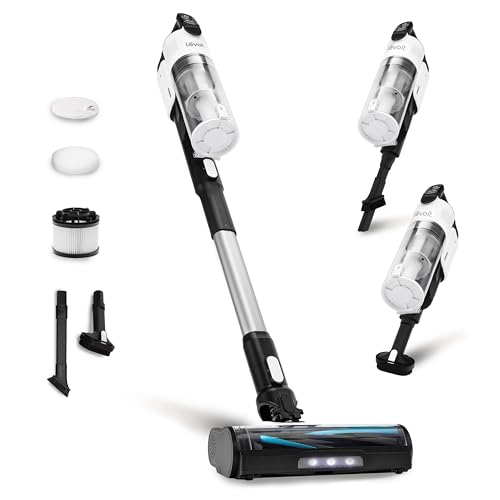
Nothing beats the grab-and-go ease of a cordless vacuum. You can whisk it from room to room, take it up stairs, and even carry it out to the car without wrestling with a cord. Models like the KQAHA Cordless Vacuum Cleaner and the Levoit Cordless Vacuum Cleaner are lightweight and self-standing, so you can pause mid-clean without propping them against furniture. Corded vacuums, by contrast, require you to find an outlet, manage the cord, and often drag a heavier canister behind you. For quick daily cleans and multi-level homes, cordless is the clear winner.
Filtration and Allergen Control: Both Can Excel
Both cordless and corded vacuums can offer HEPA filtration. The Dyson V8™ Cordless Vacuum traps 99.99% of particles as small as 0.3 microns, while the Bissell PowerClean FurGuard 280W Self-Standing features a HEPA sealed allergen system. The key difference is that corded vacuums often have larger dust cups and can maintain peak suction longer because they are not battery-limited. However, for most homes, a modern cordless vacuum with a sealed system will keep allergens locked away just as effectively. If you have severe allergies, consider a model with a HEPA filter and a sealed system, regardless of power source.
Pet Hair and Hair Wrap: Cordless Anti-Tangle Options Shine
Pet owners face a unique challenge: hair wrap. Many cordless vacuums now feature self-cleaning brushrolls or V-shaped anti-tangle designs. The Shark Cordless Vertex Pro has a self-cleaning brushroll, and the KARDV Cordless Vacuum Cleaner uses a V-shaped brush with a detangling comb. Corded vacuums can also include anti-tangle features, but they tend to be heavier and less nimble for spot-cleaning pet messes. For pet hair, a cordless stick vacuum with a dedicated pet tool and anti-tangle brush is often the more practical choice. For a deeper dive, check our best cordless stick vacuum guide.
Final Thoughts
Choosing between cordless and corded ultimately comes down to your home size, floor types, and cleaning habits. For everyday convenience, quick pickups, and multi-level homes, a cordless stick vacuum like the Shark Cordless Vertex Pro Lightweight Cordless offers impressive power and flexibility without the cord hassle. If you need raw suction for wall-to-wall carpet or have a very large home and prefer uninterrupted cleaning, a corded model still holds an edge. But for most households in 2026, the cordless category has matured enough to be the primary vacuum. The KQAHA Cordless Vacuum Cleaner is a budget-friendly option that proves you do not have to spend a fortune to get strong suction and long runtime. Whichever you choose, you are getting a capable cleaning tool that fits your lifestyle.
Related Guides
Frequently Asked Questions
Is a cordless vacuum as powerful as a corded vacuum?
Modern cordless vacuums have closed the gap significantly. Many models now deliver suction that rivals corded units, especially on hard floors and low-pile carpets. However, corded vacuums still provide more sustained, consistent power for deep cleaning high-pile carpets over long periods. For most daily cleaning, a good cordless vacuum is more than sufficient.
How long do cordless vacuum batteries last?
Battery life varies by model and mode. Entry-level cordless vacuums run about 20 to 30 minutes, while premium models can reach 60 to 65 minutes in low-power mode. High-power or turbo mode cuts runtime in half. If you have a large home, look for a vacuum with a removable battery so you can swap in a spare for extended cleaning sessions.
Do cordless vacuums lose suction over time?
All vacuums lose some suction if filters and brushrolls are not maintained. Cordless vacuums also face battery degradation after hundreds of charge cycles. To keep suction strong, clean or replace filters every three months and empty the dust cup after each use. Many cordless models now include advanced cyclonic separation to minimize clogging and maintain suction longer.
Which is better for pet hair: cordless or corded?
Both can handle pet hair, but cordless vacuums with anti-tangle brushrolls and specialized pet tools often make the job easier. The Bissell PowerClean FurGuard 280W Self-Standing is designed specifically for pet hair, with a self-cleaning brushroll and FurFinder tool. For quick spot cleans on furniture and car seats, a cordless handheld like the BLACK+DECKER dustbuster Cordless Handheld Vacuum is a great companion. For more on robot vacuums for pet owners, see our Vacuum Guides.


